
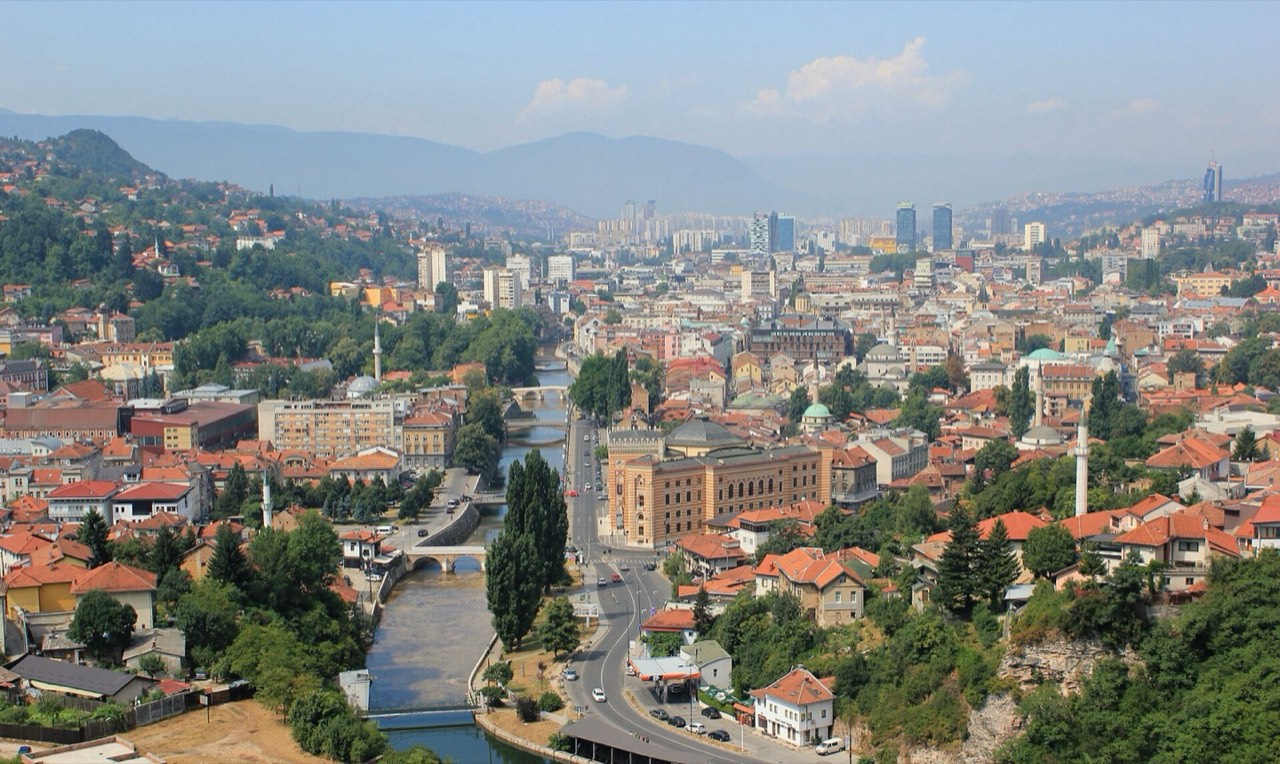
History and culture
The Ottoman trading centre of Baščaršija and Austro-Hungarian buildings preserve different layers of city history. The assassination of 28 June 1914 occurred beside the northeast end of Latin Bridge, not on its span. Sarajevo hosted the 1984 Winter Olympics and endured the 1992–1995 siege; the restored City Hall recalls both destruction and heritage preservation.
Active mosques and churches share the centre with craft lanes and museums. Food includes ćevapi with somun, klepe, stuffed onions and syrup desserts; many dishes share traditions with neighbouring regions rather than belonging exclusively to one city. Three walks follow central public streets. The war tunnel, Olympic mountains and Trebević are not included in these short routes.
Follow clothing, admission and photography rules in active mosques and churches, without interrupting services. Ask before photographing people. Respect memories of war and its victims; residential yards, burial plots and fenced areas are not tourist shortcuts.
Places
Sebilj Fountain
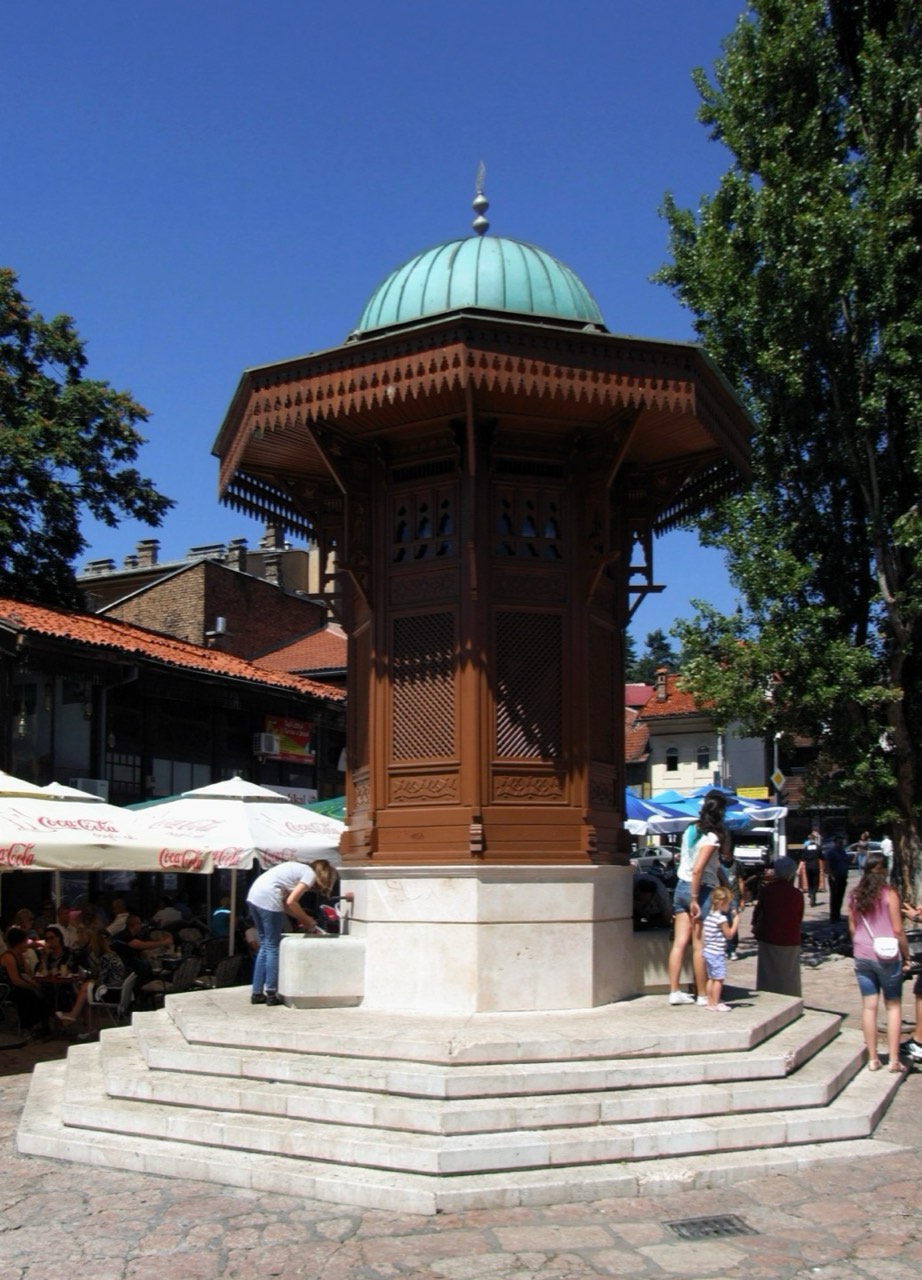
Wooden drinking-fountain pavilion on Baščaršija square.
A stone predecessor is associated with 1753 and Mehmed Pasha Kukavica. Original municipal research distinguishes its replacement with Alexander Wittek’s new pavilion in 1891 from a move roughly five metres north in 1913. This is not an unchanged eighteenth-century wooden fountain; restoration followed damage in 1992.
A useful starting point for the craft and trading quarter.
The point marks the fountain, not a similarly named guesthouse. Keep square passages clear and do not feed birds for photographs. Drinking taps do not replace current local water notices; ask about water quality if unsure.
Gazi Husrev-beg Mosque
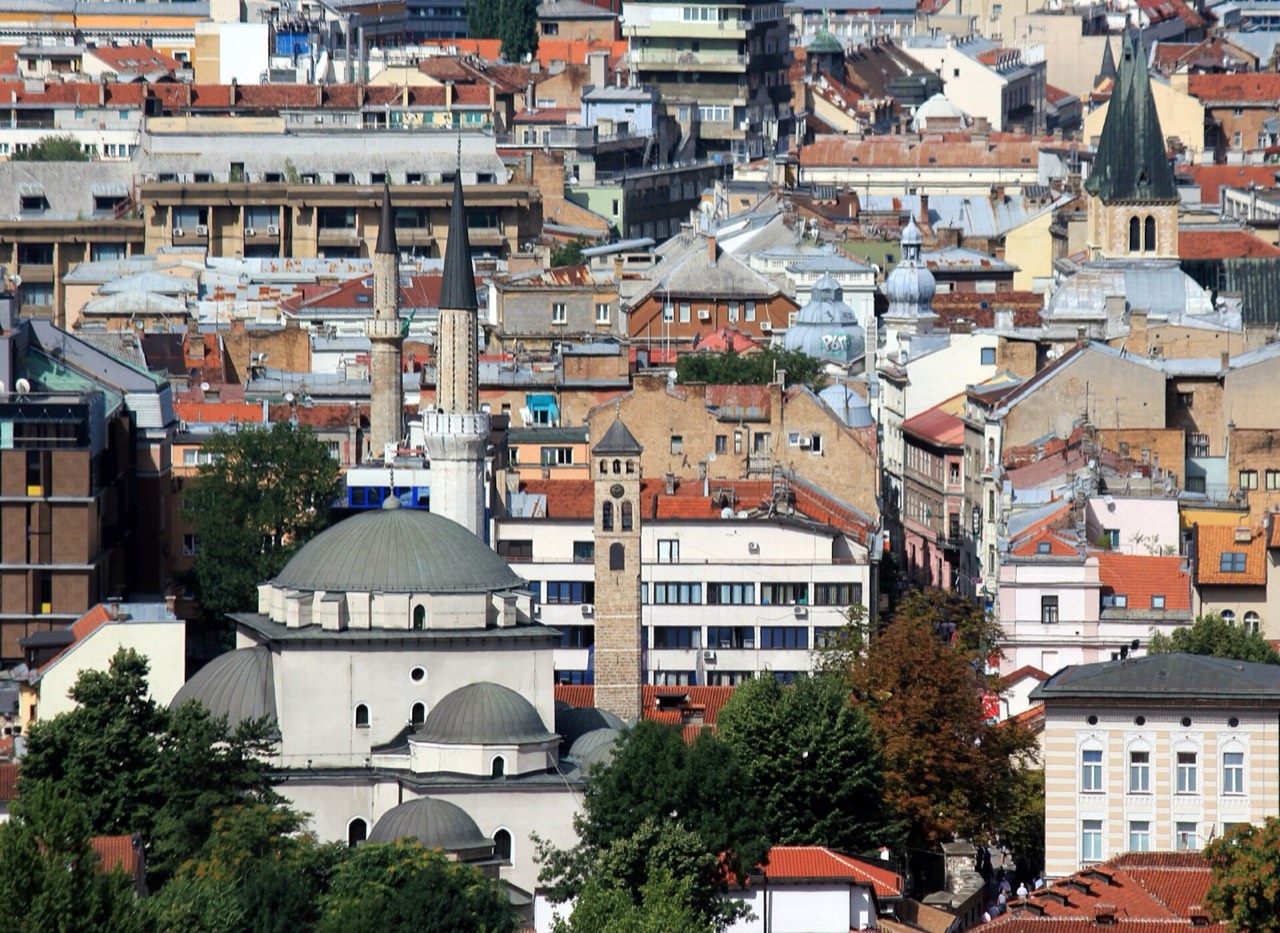
Active Ottoman mosque in the endowment complex beside Sarači.
The inscription and endowment history date the mosque to 1531; its design is attributed to architect Esir Ali. The complex preserves Gazi Husrev-beg’s charitable institutions. Mosque, madrasa, library and museum are separate buildings with distinct visiting arrangements.
It explains the religious endowment’s role in Baščaršija’s development.
The walk allows an exterior stop. Visitor windows differ from prayer times and change by season and during Ramadan; ask the information centre about dress, current hours and admission. Mosque admission does not automatically cover neighbouring institutions. Confirm photography rules separately.
Vijećnica City Hall
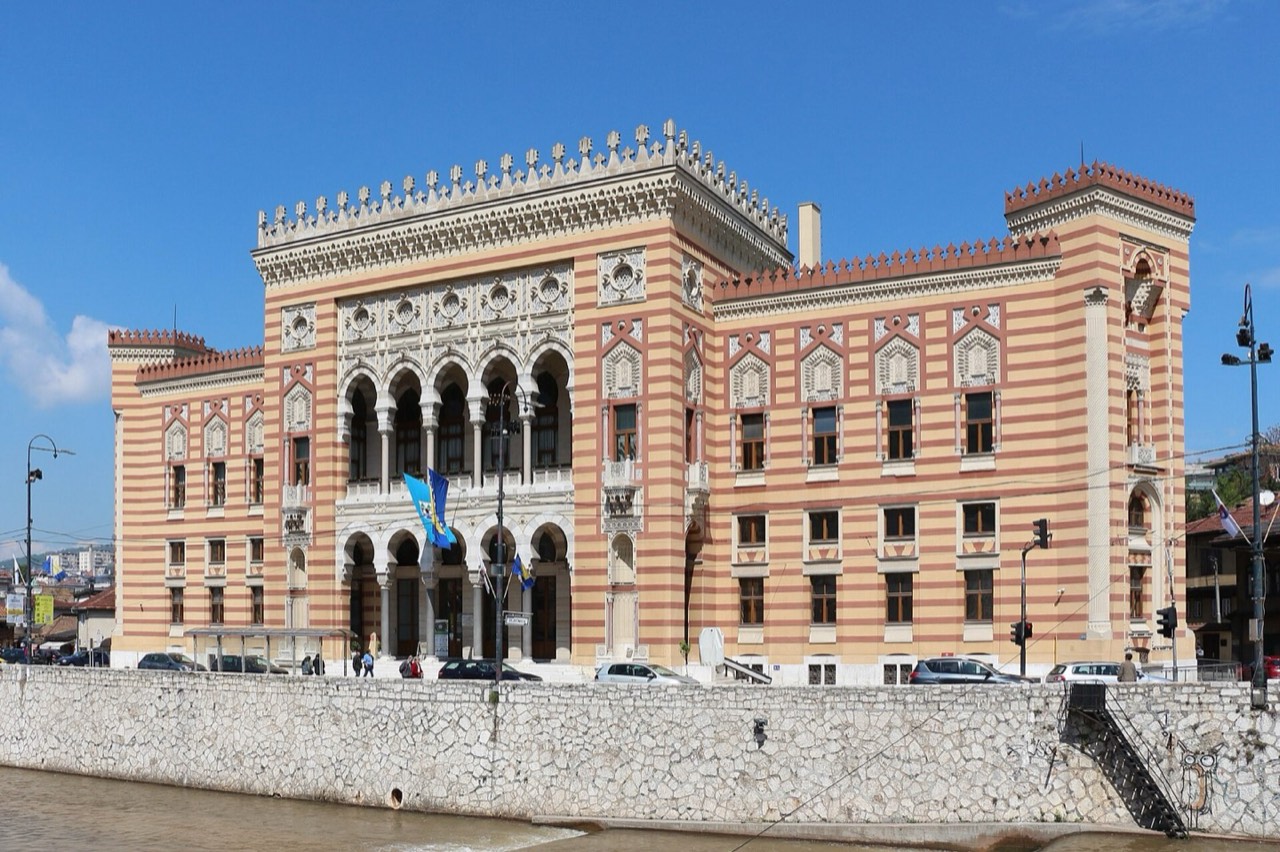
Restored civic building at the eastern edge of the old centre.
City Hall opened on 20 April 1896 and housed a library after the Second World War. Fire on the night of 25–26 August 1992 destroyed much of the building and its collections. Restoration culminated in reopening on 9 May 2014. It now hosts exhibitions, events and city council meetings.
It connects nineteenth-century civic architecture with loss and restoration.
The coordinate marks the building, not the nearby bus stop. Use Brodac pavements and the permitted path by the principal entrance, not the carriageway for photographs. Check admission and event-related opening exceptions; the exterior route does not guarantee access to every hall.
Latin Bridge
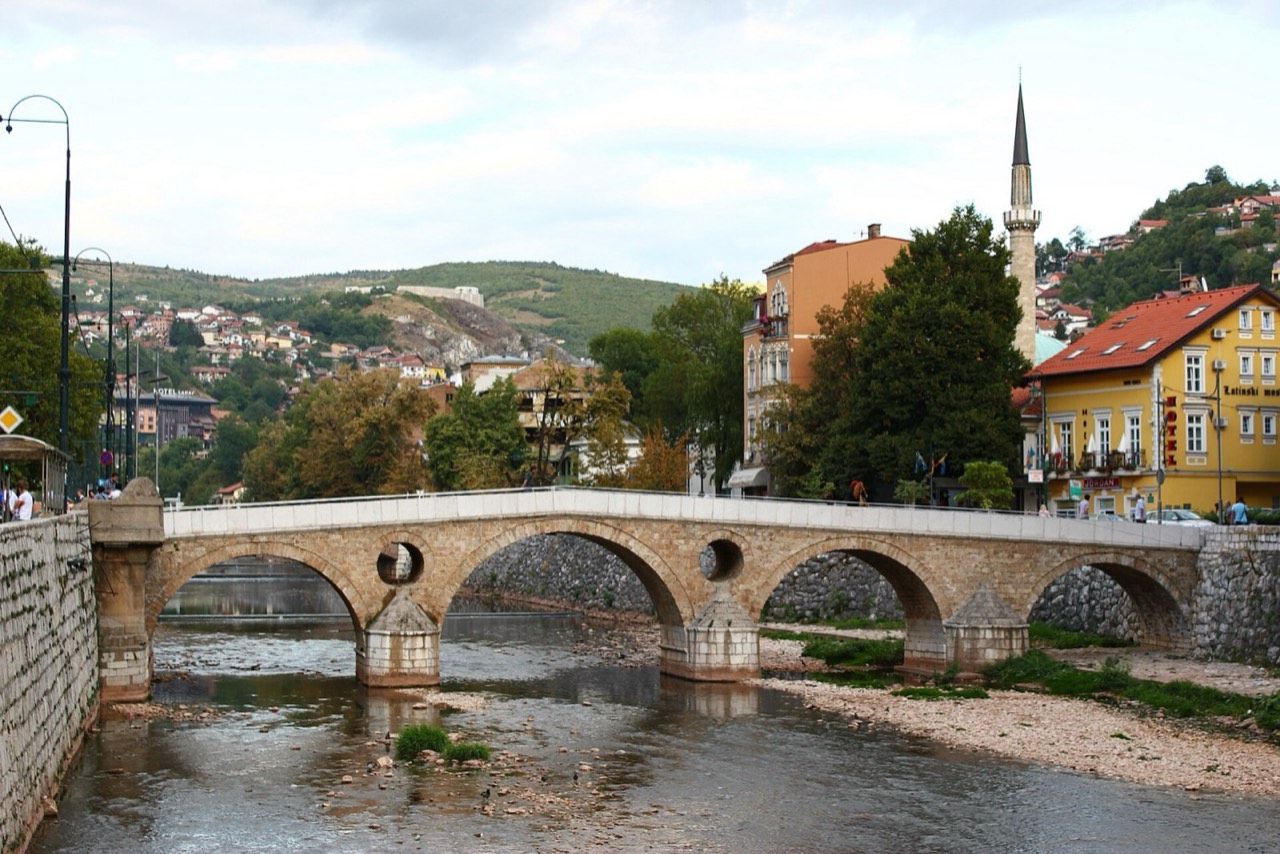
Stone pedestrian bridge over the Miljacka beside the historic 1914 assassination site.
City history records a wooden bridge in 1541. A stone predecessor suffered in the 1791 flood; the present form dates to 1798. Its name refers to the Catholic Latinluk quarter on the left bank. Franz Ferdinand and Sophie were assassinated on 28 June 1914 beside a shop at the nearby northeast corner, not in the middle of the span.
It separates the crossing’s history from the precise geography of the 1914 event.
Reach the north entrance by marked crossings over Obala Kulina bana and the tram tracks; do not walk directly through traffic towards the bridge. Do not climb river barriers. The Sarajevo 1878–1918 Museum at the northeast corner is a separate visit; its interior and ticket are not included in the walk.
Sacred Heart Cathedral
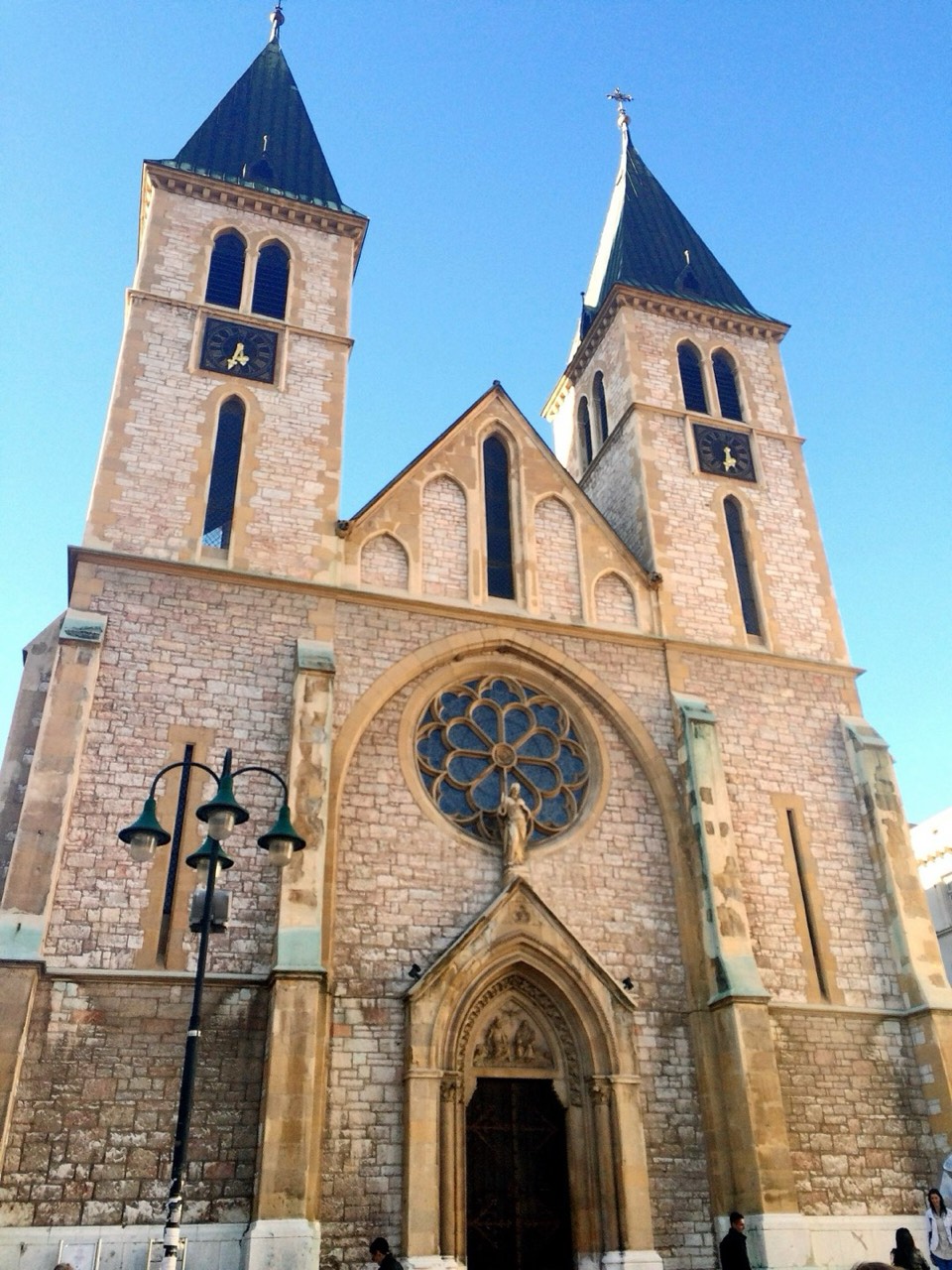
Roman Catholic cathedral with twin towers on Trg fra Grge Martića.
Josip Vancaš’s design was built from 1884; consecration followed interior work on 14 September 1889. The neo-Gothic building is associated with the first archbishop, Josip Stadler. This is the Catholic Sacred Heart Cathedral, not the Orthodox Cathedral of the Nativity of the Theotokos.
It introduces another religious and architectural layer of central Sarajevo.
View the facade from the public square, keeping access clear and respecting services. Ask staff about visitor admission and photography rather than treating an open door as permission. The short route excludes the interior; modern restorations and artwork require separate assessment for commercial images.
Brusa Bezistan
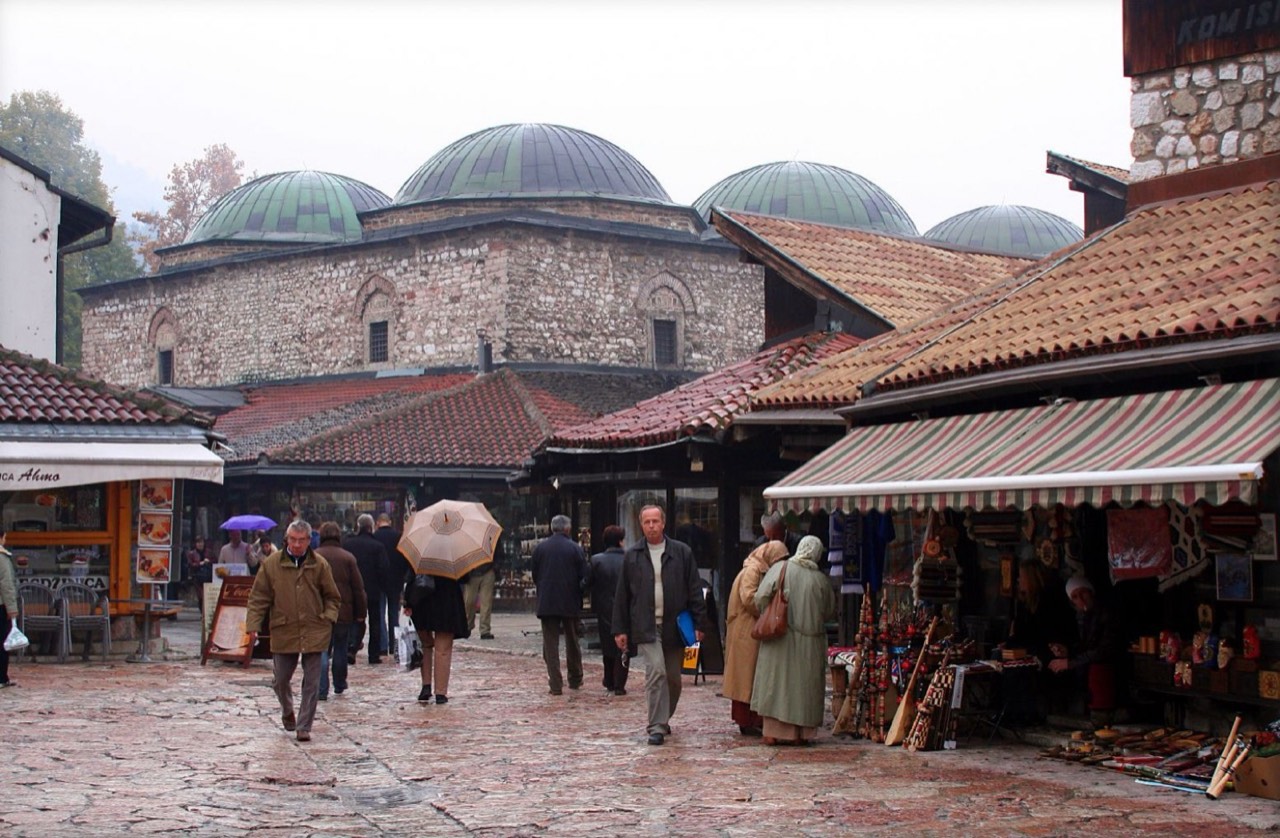
Former covered trading hall, now a Sarajevo museum branch on Abadžiluk.
Rustem Pasha founded the bezistan in 1551 for silk trading linked to Bursa. The building has six principal and two smaller domes. Following siege damage it was restored for museum displays covering archaeology and city history through Ottoman and Austro-Hungarian periods. This is not the neighbouring Gazi Husrev-beg shopping bezistan.
It distinguishes a historic trading hall from its present museum use.
At the entrance at Abadžiluk 10 check current hours, admission and photography rules. The walk allows an exterior stop, not guaranteed access to collections. Do not confuse the museum with a shopping passage; exhibits and models are not automatically free for commercial reproduction.
Walking routes
Fountain, Endowment and Museum Bezistan
From Sebilj use public square paths to Sarači and follow pedestrian Sarači west to the mosque. Continue back along Sarači to Čizmedžiluk, turn south, then take Ćurčiluk veliki east; approach Brusa Bezistan from Bazardžani and Abadžiluk using permitted passages. Do not shortcut through closed endowment courtyards. The 500 m / roughly 105 minutes include exterior stops, walking and a buffer, but exclude mosque or museum admission, prayers, queues and the full return journey.
0.5 km · 105 min
- Sebilj Fountain · 20 min at stop
- Gazi Husrev-beg Mosque · 25 min at stop
- Brusa Bezistan · 20 min at stop
Bezistan to Restored City Hall
From Brusa Bezistan reach northern Abadžiluk and follow Bravadžiluk east. At the street end use the mapped footpath and pavement beside Brodac; approach City Hall’s main entrance on the permitted pavement around the building. Where the route crosses a road, use a permitted crossing and watch traffic. Do not walk along the Obala Kulina bana carriageway or tram tracks. The 400 m / roughly 85 minutes allow exterior stops and a buffered approach; tickets, halls, events and the full return journey are excluded.
0.4 km · 85 min
- Brusa Bezistan · 20 min at stop
- Vijećnica City Hall · 25 min at stop
Cathedral, Mosque and Latin Bridge
From the cathedral square use the public approach to Ferhadija and walk east to Sarači, then the mosque. Follow public Mudželiti veliki south along its western side. Use the Zelenih beretki pavement towards Obala Kulina bana; take the marked signalised crossing by Latin Bridge’s northern approach, not a straight line through the road and rails. Finish on the permitted pedestrian bridge. The 650 m / roughly 110 minutes include exterior stops and buffered crossings; interiors, the neighbouring museum, queues and the full return journey are excluded.
0.65 km · 110 min
- Sacred Heart Cathedral · 20 min at stop
- Gazi Husrev-beg Mosque · 25 min at stop
- Latin Bridge · 20 min at stop
Food
Sarajevo Ćevapi
Small grilled skinless meat sausages served with somun bread and onions. The tourism association describes a beef-and-mutton mixture; check the actual kitchen’s meat and additions separately.
Ask about meat species and any halal requirements rather than relying on the name. Somun is normally wheat bread; yogurt and other additions contain milk. Declare allergies and ask about the shared grill; the dish name does not guarantee suitability.
Sogan Dolma
Onion layers filled with minced meat and rice. The verified local menu lists onion, meat, rice, salt and pepper; other kitchens may vary the sauce and accompaniments.
This is not automatically vegetarian dolma. Ask about meat, stock, sauce and dairy additions; check any wheat bread separately. For allergies discuss the whole recipe and shared kitchen, not just the rice.
Klepe
Small homemade pasta parcels with minced meat; the local menu specifically mentions garlic. Sauce service varies by kitchen and is not fixed here as a single universal recipe.
The dough may contain wheat and egg, and sauce may contain dairy. Ask about meat species, garlic, filling and additions; do not assume gluten-free or halal klepe without confirmation. For allergies ask about shared preparation too.
Tufahija
A sweet cooked apple with a nut filling; Sarajevo’s tourism association specifies walnuts. Syrup and decoration vary between establishments.
Nut allergy requires particular care with this dish. Ask about walnuts and other nuts, cream or other dairy decoration, and syrup ingredients. A fruit dessert is not automatically vegan; ask about contact with wheat and other allergens.
Baklava
Layered sweet pastry with nuts and syrup. The verified Sarajevo menu describes thin pastry, chopped walnuts and syrup or honey; this belongs to a wider regional tradition, not an exclusively Sarajevo invention.
Check wheat pastry, nuts, butter and other dairy, and honey if you avoid it. Syrup and fat vary by recipe. The name does not guarantee no eggs, milk or allergens from a shared bakery.
Practical information
Use pedestrian streets, pavements and marked crossings in the old centre: roads and tram tracks run beside the Miljacka. The airport publishes a Centrotrans bus to Baščaršija / Bentbaša; directional timetables distinguish weekdays and weekends, so check your specific service, stop, fare and luggage terms before travelling. Do not assume a 24-hour or hourly bus every day. Agree taxi fares and luggage charges beforehand. The intercity bus station and airport require separate journeys, not stops on these central walks.
Secure belongings in crowds and on transport; take care on wet stone and winter ice. Stay behind river barriers and use permitted crossings over roads and tram tracks. Because of mines and unexploded ordnance, do not leave established safe routes for abandoned buildings, woodland or neglected verges; a city itinerary does not certify clearance of all surroundings. These walks use central public streets and allow exterior stops. Queues, interiors, mountain trips and the full return journey are excluded; the entire route is not verified step-free.
Convertible mark
The currency is the convertible mark, BAM, also written KM on price lists. The Central Bank’s official rate is EUR 1 = BAM 1.95583; transaction fees and retail exchange terms can differ. Do not assume euros are accepted everywhere. Check card acceptance and keep some cash in marks for small purchases.
Tips and the bill
Check service, bread or cover charges before ordering and the final bill before payment. Terms depend on the establishment: a mandatory charge in one menu is not a national rule. If you want to tip, choose an amount you are comfortable with and ask separately whether card tipping is possible.
Getting around
Use pedestrian streets, pavements and marked crossings in the old centre: roads and tram tracks run beside the Miljacka. The airport publishes a Centrotrans bus to Baščaršija / Bentbaša; directional timetables distinguish weekdays and weekends, so check your specific service, stop, fare and luggage terms before travelling. Do not assume a 24-hour or hourly bus every day. Agree taxi fares and luggage charges beforehand. The intercity bus station and airport require separate journeys, not stops on these central walks.
Emergency numbers
122 is police; 123 is the fire service; 124 is emergency medical assistance; 121 is civil protection. Give the exact address or coordinates and describe the incident. Do not replace these verified local numbers with an assumed universal number from another country. An offline pack cannot provide phone coverage. Source: kucz.sbk-ksb.gov.ba/opce-upute/.
Electricity
Supply is 230 V / 50 Hz; types C and F use round pins. Check plug compatibility, earthing and the voltage marked on your device. An adapter changes the connection, not the voltage; an incompatible device may require a converter.
Connectivity and offline use
Check Bosnia and Herzegovina in your SIM/eSIM plan. Reduced EU–Western Balkans prices do not mean automatic free EU roaming for every SIM. Ask your operator about packages, limits and calls. Save maps, accommodation details and tickets beforehand; continuous signal is not guaranteed.
Verified sources and photo licences
- Central Bank of Bosnia and Herzegovina: BAM and official EUR 1 = BAM 1.95583, not retail fee guarantees · cbbh.ba
- Federation cantonal civil protection authority: direct numbers 121/122/123/124 · kucz.sbk-ksb.gov.ba
- Electrical Safety First: 230 V, 50 Hz, C/F; adapter versus voltage converter · www.electricalsafetyfirst.org.uk
- Regional Cooperation Council: reduced offers depend on participating operator and product, not universal EU roaming · www.rcc.int
- UK government current advice: pickpockets, agree taxi fare and luggage charges, mines/UXO beyond safe established routes and in abandoned buildings · www.gov.uk
- Primary transport information: recheck operating day, fare and luggage terms, no assumed 24-hour service · sarajevo-airport.ba
- Sarajevo Canton Tourism Association, complete pages 5/7/9 viewed: capital, 1984 Olympics, siege, street map and local food; outdated electrical and blanket drinking-water advice not reused · www.visitsarajevo.ba
- Municipality Stari Grad, Haberi issue 1, original Alija Ibrović article, complete page 19 viewed: 1753 predecessor, replacement 1891, moved north 1913 · starigrad.ba
- City of Sarajevo: Sebilj restoration after 1992 damage; simplified 1913 date distinguished from earlier replacement in municipal original research · www.sarajevo.ba
- Gazi Husrev-beg endowment: mosque inscription 1531 and architect Esir Ali · begovadzamija.ba
- Mosque operator: separate visitor windows, prayer restrictions and admission; undated price not frozen as current · begovadzamija.ba
- City Hall operator: opening 20 April 1896, fire night 25–26 August 1992, restoration and reopening 9 May 2014 · www.vijecnica.ba
- City of Sarajevo: bridge first mentioned 1541, flood 1791, present form 1798; Latinluk quarter · www.sarajevo.ba
- Museum of Sarajevo operator: 28 June 1914 at Schiller shop corner of Obala Kulina bana and Zelenih beretki, not bridge deck · www.muzejsarajeva.ba
- Catholic weekly institutional church history: Josip Vancaš, construction 1884 onward, consecration 14 September 1889; not the compromised cathedral domain · www.nedjelja.ba
- Tourism Association complete page 9: beef/mutton ćevapi with somun and onions; walnut-filled apple tufahija · www.visitsarajevo.ba
- Kibe Mahala own menu: minced-meat/garlic klepe, onion/meat/rice sogan dolma, walnut pastry baklava; one restaurant cover charge is not national tipping policy · www.kibemahala.ba
- Aščinica own current menu corroborates local klepe, dolma, tufahije and baklava availability, not universal daily supply · ascinica.ba
- Restaurant own menu: establishment-specific cover charge, not a universally mandatory tip · www.kibemahala.ba
- OpenStreetMap contributors, ODbL 1.0: actual Sebilj fountain geometry, not a namesake business or bus stop; https://www.openstreetmap.org/copyright · www.openstreetmap.org
- OpenStreetMap contributors, ODbL 1.0: actual Gazi Husrev-beg Mosque geometry, not a namesake business or bus stop; https://www.openstreetmap.org/copyright · www.openstreetmap.org
- OpenStreetMap contributors, ODbL 1.0: actual City Hall building geometry, not a namesake business or bus stop; https://www.openstreetmap.org/copyright · www.openstreetmap.org
- OpenStreetMap contributors, ODbL 1.0: actual Latin Bridge geometry, not a namesake business or bus stop; https://www.openstreetmap.org/copyright · www.openstreetmap.org
- OpenStreetMap contributors, ODbL 1.0: actual Sacred Heart Catholic Cathedral geometry, not a namesake business or bus stop; https://www.openstreetmap.org/copyright · www.openstreetmap.org
- OpenStreetMap contributors, ODbL 1.0: actual Brusa Bezistan museum geometry, not a namesake business or bus stop; https://www.openstreetmap.org/copyright · www.openstreetmap.org
- OpenStreetMap contributors, ODbL 1.0: mapped Sarači route geometry; road/tram crossings and interiors distinct; https://www.openstreetmap.org/copyright · www.openstreetmap.org
- OpenStreetMap contributors, ODbL 1.0: mapped Ferhadija route geometry; road/tram crossings and interiors distinct; https://www.openstreetmap.org/copyright · www.openstreetmap.org
- OpenStreetMap contributors, ODbL 1.0: mapped cathedral square approach route geometry; road/tram crossings and interiors distinct; https://www.openstreetmap.org/copyright · www.openstreetmap.org
- OpenStreetMap contributors, ODbL 1.0: mapped Čizmedžiluk route geometry; road/tram crossings and interiors distinct; https://www.openstreetmap.org/copyright · www.openstreetmap.org
- OpenStreetMap contributors, ODbL 1.0: mapped Ćurčiluk veliki route geometry; road/tram crossings and interiors distinct; https://www.openstreetmap.org/copyright · www.openstreetmap.org
- OpenStreetMap contributors, ODbL 1.0: mapped Bazardžani route geometry; road/tram crossings and interiors distinct; https://www.openstreetmap.org/copyright · www.openstreetmap.org
- OpenStreetMap contributors, ODbL 1.0: mapped Abadžiluk route geometry; road/tram crossings and interiors distinct; https://www.openstreetmap.org/copyright · www.openstreetmap.org
- OpenStreetMap contributors, ODbL 1.0: mapped Bravadžiluk route geometry; road/tram crossings and interiors distinct; https://www.openstreetmap.org/copyright · www.openstreetmap.org
- OpenStreetMap contributors, ODbL 1.0: mapped Bravadžiluk pavement approach route geometry; road/tram crossings and interiors distinct; https://www.openstreetmap.org/copyright · www.openstreetmap.org
- OpenStreetMap contributors, ODbL 1.0: mapped Brodac pavement route geometry; road/tram crossings and interiors distinct; https://www.openstreetmap.org/copyright · www.openstreetmap.org
- OpenStreetMap contributors, ODbL 1.0: mapped City Hall front entrance footpath route geometry; road/tram crossings and interiors distinct; https://www.openstreetmap.org/copyright · www.openstreetmap.org
- OpenStreetMap contributors, ODbL 1.0: mapped Mudželiti veliki route geometry; road/tram crossings and interiors distinct; https://www.openstreetmap.org/copyright · www.openstreetmap.org
- OpenStreetMap contributors, ODbL 1.0: mapped Zelenih beretki pavement route geometry; road/tram crossings and interiors distinct; https://www.openstreetmap.org/copyright · www.openstreetmap.org
- OpenStreetMap contributors, ODbL 1.0: mapped Latin Bridge signalised crossing route geometry; road/tram crossings and interiors distinct; https://www.openstreetmap.org/copyright · www.openstreetmap.org
- Sebilj Fountain · starigrad.ba
- Gazi Husrev-beg Mosque · begovadzamija.ba
- Vijećnica City Hall · www.vijecnica.ba
- Latin Bridge · www.sarajevo.ba
- Sacred Heart Cathedral · www.nedjelja.ba
- Brusa Bezistan · www.muzejsarajeva.ba